Comfort or Complacent —
Breaking the Invisible Ceilings That Hold Businesses Back
August 27, 2026
I worked my way through college honing sales skills in a commission-based position that allowed me to graduate with no student loan debt. I trained under a couple of sales managers before becoming one of the youngest GM’s in my industry niche.
Fortunately, I found a mentor in Jerry Vincent. At the time, Jerry was the Eastern Roland CK Area Sales Rep — but that title only hinted at his pedigree. Before Roland, Jerry spent a long career with Lowrey during the era when Lowrey was part of Chicago Musical Instruments (CMI), which later evolved into Norlin Corporation.
CMI/Norlin wasn’t just a distributor — it was one of the major powerhouses in the music industry. Their portfolio included Gibson, Moog, Lowrey, Olds Band Instruments, Cordovox, and other influential brands. They shaped entire categories of the music business.
Jerry came from that world. He wasn’t just a rep — he was a product of an era when the biggest brands were run by the sharpest minds in the industry. His experience carried weight, and when he spoke, you listened.
Jerry shared many lessons with me over the years. One of the first was about the manager I eventually replaced. Under the original owner, that manager had a very low comfort zone regarding his earnings. Once he reached a certain level of commissions, he coasted — content with what he was making. Jerry explained that many people place an invisible ceiling on their earnings based on some arbitrary number.
Later, when the second owner took over the store, I became part of an eight‑store chain with around 50 salespeople. That’s when I met the company’s top salesman — a guy with no comfort ceiling whatsoever. If he sold six pianos in a day, he’d hang around in case the guy sweeping the mall needed one. If he spoke with eight prospects and sold seven, he’d talk about the one he didn’t get.
The contrast between the two men was staggering. The manager I replaced had been content making $60k a year — in late‑80s dollars. Meanwhile, the top salesman had a month where he earned $19k in commissions (also late‑80s dollars). When I asked him about it, he told me he was disappointed he didn’t hit $20k. More importantly, he showed me I should expect to have $10k months.
It was a complete mind shift.
“Whether you think you can, or you think you can’t — you’re right.”
— Henry Ford
Until Roger Bannister broke the four-minute mile in 1954, it was considered physically impossible. Over the next two years, ten other men broke the barrier. Once someone shows you what’s possible, your brain rewires.
Seeing the earning potential of the industry turned a good college job into a career — and began the journey that eventually led to founding Royal Music.
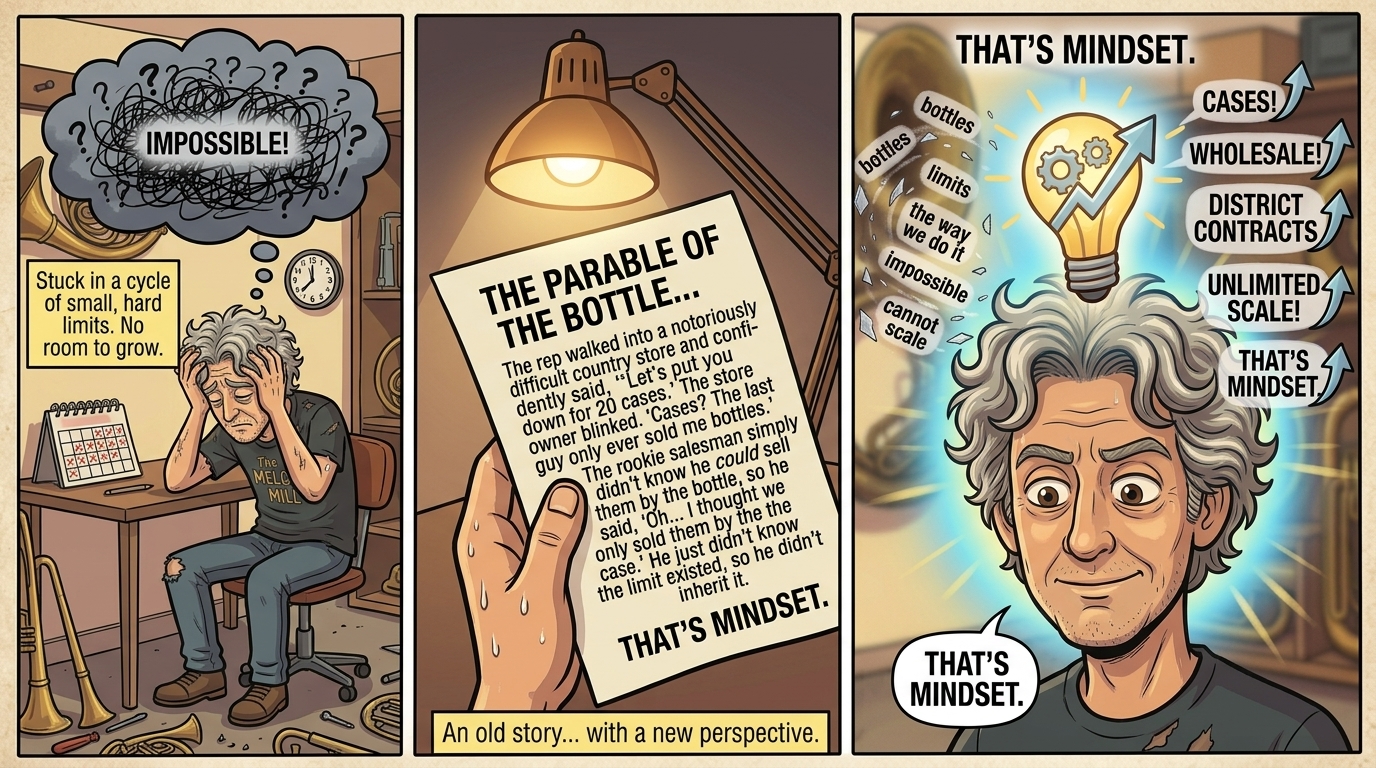
The Parable of the Bottle
A beverage company once hired a rookie salesman and assigned him a notoriously difficult rural territory. The previous rep had struggled for years, barely selling anything.
On his first day, he walked into a small country store, checked the shelves, and confidently said, “Looks like you’re running low. Let’s put you down for 20 cases.”
The store owner blinked. “Cases? The last guy only ever sold me bottles.”
He froze — because he genuinely didn’t know he could sell them by the bottle. No one had told him. So he simply said, “Oh… I thought we only sold them by the case.”
It wasn’t a tactic. He didn’t bluff. He didn’t manipulate. He just didn’t know the limitation existed — so he didn’t behave like it did.
And because he didn’t know the ceiling, he didn’t inherit it.
That’s mindset.
Industry Comfort Zones
It’s surprising how many small businesses are trapped in the same pattern. They set parameters that cap growth. Many piano stores operate with only one or two salespeople. In a previous post, I shared a promo I ran at Royal Music — click here to read “Office of the Salesman of the Month.” The feedback I got was: Great idea, but we don’t have enough salespeople to do it.
Relying on a skeleton crew is putting all your eggs in one or two baskets. What happens if one quits, moves, gets sick, has a slump, or simply ages out? If we want our businesses to grow, we must grow the staff.
The showroom with two salespeople — who are likely on Medicare — should hire a young rookie and train them. Seed the talent pool for the future.
This challenge exists at the industry level too. Part of the stagnation in our industry comes from manufacturers being complacent with little growth. I wrote about this in The Arrogance of Complacency (MMR Magazine, 2018), and I’m exploring it further in my upcoming book Sometimes Poop Floats.
“You will be the same person in five years as you are today except for the people you meet and the books you read.”
— Charlie “Tremendous” Jones
Call to Action — Mentor + Rally Cry
Every turning point in my career came from someone expanding my sense of what was possible — Jerry Vincent, the top salesman who aimed higher, the rookie who unknowingly sold cases, the authors and mentors whose words still echo today.
Growth never came from comfort. It came from exposure — to new people, new ideas, and higher baselines.
If your business feels stuck, it’s rarely the market. It’s the mindset. It’s the assumptions. It’s the ceiling you didn’t realize you built.
You can run a store with two salespeople and hope nothing goes wrong. You can sell bottles and pray someone buys a case. You can aim for $60k when $20k months (in 1980s dollars!) were already being hit by people who simply expected more.
But you cannot grow by staying comfortable.
Backbeat is designed to be the place where those ceilings get shattered — where you meet the people who stretch you, where you encounter the ideas that change your next five years, where you stop playing small and start building the version of your business you know is possible.
If you’re ready to expand your comfort zone — intentionally — then you belong in the room.
Step up. Show up. Build something tremendous.